Accent Microcell is the cleanest listed expression of the excipient thesis set out in this primer: a focused, export-led microcrystalline cellulose producer with a US Drug Master File, an essentially debt-free balance sheet and a five-year record of compounding revenue in the high teens without dilution or leverage. FY26 was its strongest year — total income up 31% to Rs 355.8 crore and profit after tax up 33% to Rs 43.9 crore — and CARE upgraded it to A–/Stable in March 2026.
Our reservation is entirely about timing. The company is capacity-constrained: it sold roughly 15,000 tonnes in FY26 against 9,200 MTPA of installed capacity, buying in about 30% of volume at a distribution spread rather than a conversion margin. The answer to that is Unit-III at Nayka, Kheda — and Unit-III has slipped from October 2025 to April 2026 and then again, with no revised date, on monsoon disruption and pending environmental and power-line approvals. Meanwhile the stock has risen from a 52-week low of Rs 238 to Rs 697.
At roughly 37x FY26 earnings and about 6x book, the shares already discount a plant that has not yet made a kilogram. Our SOTP-free, earnings-based target price of Rs 730 — 28x FY28E EPS of Rs 25.5 — implies 5% upside. We initiate with a HOLD.
Excipient revenue is unusually sticky. An excipient has no standalone approval; it is qualified inside the customer's drug filing, so replacing a supplier means a monograph check, a DMF reference, an audit, formulation trials, stability data and a regulatory variation — three to five years in total. Accent's DMF, FSSC 22000/GMP/HACCP certifications and Kosher and Halal approvals are what convert a commodity powder into that kind of relationship. Roughly half of income is export, and the top ten customers were about 44% of income in FY25 — concentrated, but concentrated in relationships that are slow to lose.
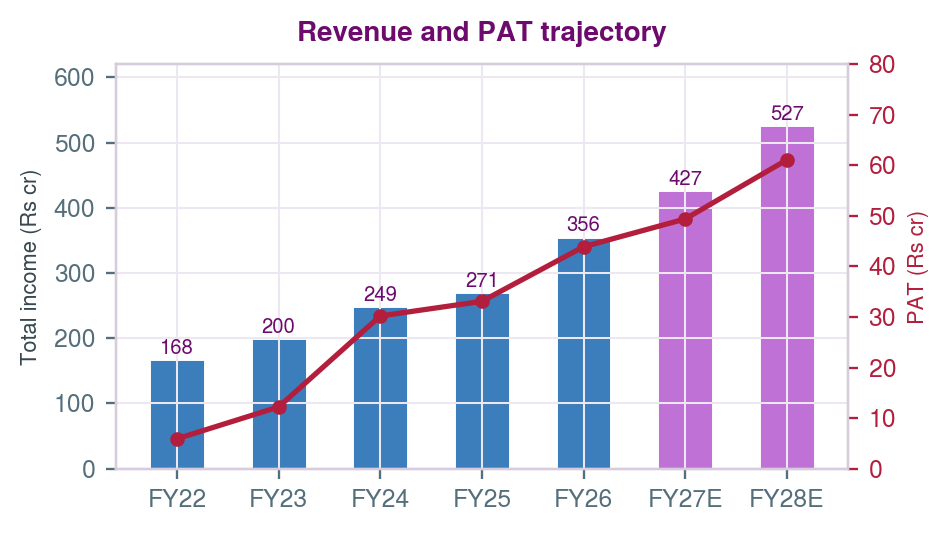
Source: Company filings; CARE Ratings; Dart Consultants estimates for FY27E–FY28E.
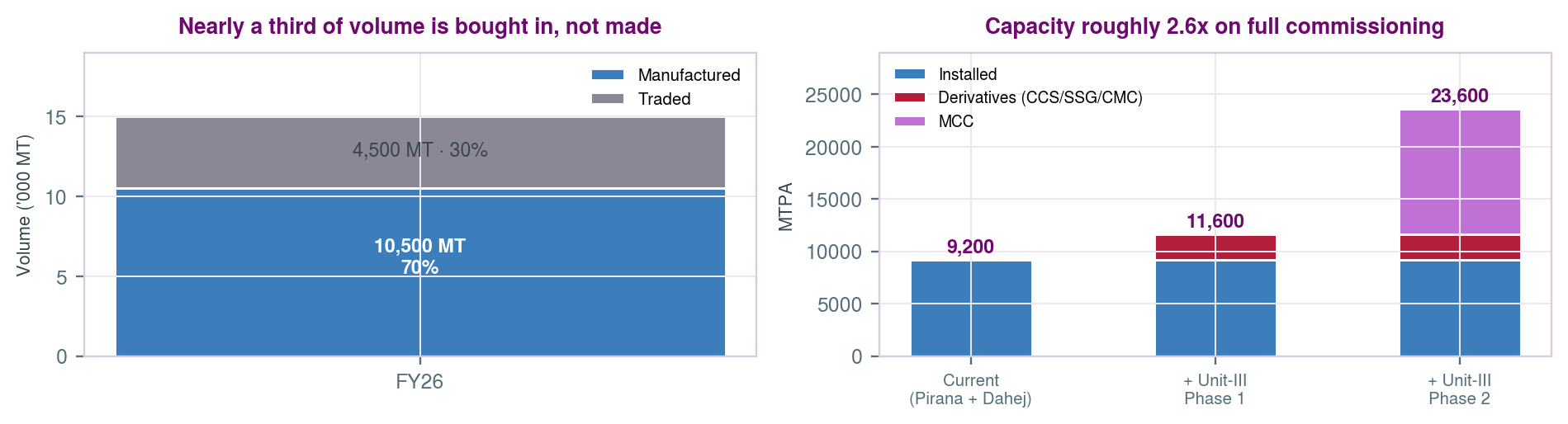
Source: Company disclosures. FY26 volume of ~15,000 MT comprised approximately 70% manufactured and 30% traded. Capacity additions are as announced; Phase 2 timing is not confirmed.
The single most important governance fact about Accent Microcell is structural rather than behavioural. The company is listed on the NSE Emerge SME platform, and under Regulation 15(2) of SEBI's Listing Obligations and Disclosure Requirements, entities listed on an SME exchange are exempt from Regulations 17 to 27 — the provisions that govern board composition, the audit committee, the nomination and remuneration committee, related-party approval and much else. Almost the entire corporate governance code that an investor would take for granted in a main-board company is, for Accent, voluntary.
Two qualifications matter. First, SEBI narrowed that relief with effect from 1 April 2025: an SME-listed entity whose paid-up equity capital exceeds Rs 10 crore or whose net worth exceeds Rs 25 crore must comply with Regulation 23 on related-party transactions. Accent's paid-up capital of approximately Rs 24 crore and net worth well above Rs 250 crore put it comfortably past both thresholds, so RPT governance now binds. Second, SME issuers report half-yearly rather than quarterly; that concession ends once post-issue paid-up capital crosses Rs 25 crore, a line Accent sits just below. Any meaningful further equity issuance would trigger quarterly reporting — which we would regard as a positive.
On the compliance record we can observe: the fourteenth annual general meeting was held on 31 July 2026 and all nine resolutions passed, covering the FY26 audited accounts, a Re 1 dividend, director re-appointments and the appointment of a new independent director. A statutory cost audit was conducted by C. B. Modh & Co., Ahmedabad. CARE Ratings upgraded the company to A–/Stable and A2+ in March 2026, which at minimum implies satisfactory information flow to an external assessor. We are not aware of any regulatory penalty, exchange action, auditor qualification or restatement.
It maintains the architecture it is not required to maintain. Despite the Regulation 15(2) exemption, the board operates an Audit Committee, a Nomination and Remuneration Committee and a CSR Committee.
The Audit Committee is independently chaired. Ms Shreyaben Shah, a non-executive woman independent director, chairs it, with a second independent director as a member — two of three members independent, which is the standard Regulation 18 would impose if it applied.
The NRC is entirely independent. All three members are non-executive independent directors, which is stricter than the main-board requirement.
Capital has been raised in ways that treat minorities equally. The June 2025 rights issue of roughly Rs 39.8 crore at Rs 135 per share was offered pro-rata to all shareholders. This is a materially fairer instrument than a preferential allotment to insiders, and we weight it positively.
The balance sheet removes a classic SME risk. Gearing of 0.01x and interest cover above sixty times mean there is little scope for the promoter-guarantee and related-party-lending structures that cause most small-cap governance failures. Expansion is funded from IPO and rights proceeds, not debt.
Cash is being returned. A Re 1 dividend was declared for both FY25 and FY26 — modest, but a discipline many growth-stage SME issuers avoid.
The board is promoter-family dominated and executive-heavy. Four of the seven directors — the Chairman, the Managing Director and two whole-time directors — are members of the Patel promoter family and all four are executive. Three directors are independent, or about 43% of the board. Under Regulation 17, a main-board company with an executive promoter as chairperson must have at least half the board independent. Accent would not meet that bar, though as an SME issuer it is not obliged to.
The Managing Director is also the Chief Financial Officer. Mr Ghanshyam Patel holds both roles. In our view this is the most consequential governance feature on this page. A separate CFO is one of the few structural checks on a chief executive's financial reporting, and combining the roles removes it. It is common and lawful in companies of this size; it is still a genuine weakness, and one we would expect to be addressed as revenue scales past Rs 500 crore.
The MD and CFO sits on the Audit Committee. The committee that oversees financial reporting includes the executive responsible for producing it. Two of three members are independent, so he cannot outvote them, but the arrangement dilutes the committee's purpose.
Compliance-officer turnover. The Company Secretary and Compliance Officer resigned with effect from 7 December 2024, and a successor was appointed on 3 March 2025 — a gap of approximately three months. That is within the statutory window for filling the vacancy, but the role was unoccupied during it.
Independent director churn. Mr Chintan Bhatt resigned as a non-executive independent director effective 29 June 2026, citing an inability to devote sufficient time to the company's affairs, and simultaneously vacated the chair of the Nomination and Remuneration Committee. A replacement independent director was approved at the AGM about a month later, so the board was restored quickly. The stated reason is benign on its face; the loss of a committee chair is nonetheless a disruption.
Half-yearly reporting. Investors go six months between financial data points. During a capacity expansion that has already slipped twice, that is a real information cost, and it is the reason we place weight on the credit-rating agency's interim commentary.
An unexplained promoter stake reduction. Promoter holding fell by 2.45 percentage points in the most recent quarter, to approximately 53%. We have not located a company explanation. It may be a mechanical consequence of the rights issue not being subscribed pro-rata across the promoter group, or it may be a sale — and under half-yearly reporting we may not know for some time.
On the evidence available to us, we identify no red flags of the severity that would make the shares uninvestable on governance grounds. Specifically, we are not aware of an auditor resignation, a qualified or adverse audit opinion, a financial restatement, a disclosed promoter share pledge, a regulatory penalty or exchange action, or material undisclosed litigation.
That conclusion carries an important caveat, which we state plainly rather than bury. Absence of evidence is not evidence of absence. SME-platform disclosure is thinner, reporting is less frequent, and analyst and journalist scrutiny is far lighter than for a main-board company. A clean record observed through a narrow window is worth less than a clean one observed through a wide one, and an investor should size a position accordingly rather than treat the absence of bad news as positive news.
Whether the Managing Director and Chief Financial Officer roles are separated as the company scales. The credentials of the newly appointed independent director, and whether independent strength is maintained at three or more; who takes the NRC chair. Related-party transaction disclosures now that Regulation 23 applies — for an SME entity, an RPT is material above Rs 50 crore or 10% of consolidated turnover, whichever is lower. Any further movement in promoter holding, and whether it is explained. A trigger to quarterly reporting if paid-up capital crosses Rs 25 crore. Migration to the main board, which would bring Regulations 17 to 27 into force in full. We would treat a voluntary migration as a meaningful positive signal. Monitoring-agency reporting on the use of IPO and rights proceeds against stated objects, given that Unit-III has slipped twice.
Adequate, better than the SME average, and structurally under-checked. The company voluntarily maintains committees it could dispense with, chairs them independently, funds itself without leverage and raises capital pro-rata. Against that, the board is family-dominated, the chief executive also controls the finance function and sits on the committee that reviews it, and the reporting cadence is half the market norm.
None of this is a reason to avoid the shares. It is a reason to require a wider margin of safety than the operating numbers alone would suggest — which is part of why we rate the stock HOLD at a price that already discounts successful execution.
FY26 PAT of Rs 43.9 crore on 24.0 million shares gives FY26 EPS of Rs 18.65. Applying a constructed FY27E and FY28E EPS of Rs 20.6 and Rs 25.5 (partial Unit-III contribution, falling traded share), we apply a target multiple band around the current trailing multiple to reflect execution risk at the plant rather than assuming further re-rating:
| Basis | FY28E | Multiple | Implied value |
|---|---|---|---|
| Earnings multiple — bear | EPS 25.5 | 22x | 561 |
| Earnings multiple — base | EPS 25.5 | 28x | 714 |
| Earnings multiple — bull | EPS 25.5 | 34x | 867 |
| EV/EBITDA cross-check (base) | EBITDA 91.0 | 19x | 721 |
| Target price (rounded) | 730 | ||
| CMP | 697 | ||
| Implied upside | 5% |
Source: Dart Consultants estimates. The base multiple of 28x reflects a debt-free business compounding earnings in the high teens, discounted for SME listing, half-yearly reporting and an unproven project timetable. The company is essentially debt-free, so enterprise value approximates market capitalisation.
This is the higher-quality of the two listed Indian excipient businesses and, on a three-to-five-year view, the more likely compounder. But at Rs 697 the shares sit inside the range that successful execution would justify, which leaves no margin for a third delay at Unit-III.
Move to BUY on: Unit-III Phase 1 in commercial production with derivative revenue disclosed separately; traded volume share falling below 20%; realisation per tonne rising; or a pullback toward Rs 580–600.
Move to SELL on: a further unexplained project delay; blended margin falling below 15% as industry capacity lands; or the loss of a top-ten customer.
| Year to March | FY23 | FY24 | FY25 | FY26 | FY27E | FY28E |
|---|---|---|---|---|---|---|
| Revenue from operations | 197.3 | 245.5 | 264.6 | 349.0 | 420.0 | 520.0 |
| Other income | 2.5 | 3.6 | 6.4 | 6.8 | 7.0 | 7.0 |
| Total income | 199.8 | 249.1 | 271.0 | 355.8 | 427.0 | 527.0 |
| Change (yoy, %) | — | 24.7 | 8.8 | 31.3 | 20.0 | 23.4 |
| Total expenditure | 185.0 | 211.6 | 227.2 | 297.5 | 356.4 | 436.0 |
| EBITDA | 16.0 | 41.2 | 42.0 | 57.0 | 70.6 | 91.0 |
| EBITDA margin (%) | 8.1 | 16.8 | 15.9 | 16.3 | 16.8 | 17.5 |
| Depreciation | 3.5 | 5.5 | 6.1 | 7.5 | 11.0 | 15.0 |
| Interest | 1.2 | 1.1 | 0.3 | 0.5 | 1.0 | 1.5 |
| Profit before tax | 14.8 | 36.5 | 43.8 | 58.3 | 65.6 | 81.5 |
| Tax | 2.6 | 6.4 | 10.7 | 14.4 | 16.2 | 20.4 |
| Profit after tax | 12.2 | 30.2 | 33.1 | 43.9 | 49.4 | 61.1 |
| EPS (Rs) | 9.5 | 18.7 | 14.9 | 18.7 | 20.6 | 25.5 |
| Dividend per share (Rs) | — | — | 1.0 | 1.0 | — | — |
Source: Company filings and CARE Ratings publications for FY23–FY26; Dart Consultants estimates for FY27E–FY28E. FY26 EBITDA is derived from disclosed half-yearly operating profit. EPS reflects the share count in each year, which rose through the December 2023 IPO and the June 2025 rights issue.
| Year to March | FY24 | FY25 | H1 FY26 | FY26 |
|---|---|---|---|---|
| Net worth (Rs cr) | — | ~211 | 252.6 | ~276 |
| Book value per share (Rs) | — | ~100 | — | ~115 |
| Overall gearing (x) | 0.08 | 0.01 | 0.00 | nil |
| Interest coverage (x) | 36.7 | 129.1 | 64.1 | — |
| Gross cash accruals (Rs cr) | — | 35.2 | — | — |
| Operating cycle (days) | 88 | 104 | — | — |
| Working-capital limit utilisation (%) | — | — | 10.4 | — |
| RoE (%) | — | 17.5 | — | 17.7 |
| Installed capacity (MTPA) | 9,200 | 9,200 | 9,200 | 9,200 |
| Sales volume (MT) | — | — | — | ~15,000 |
| Exports (% of total income) | 59 | 51 | — | — |
| Top-10 customer concentration (%) | 39.0 | 44.1 | — | — |
Source: CARE Ratings press release dated 25 March 2026; company filings. We have deliberately restricted this table to disclosed or directly derivable metrics rather than modelling a full balance sheet, because the company reports half-yearly and several line items are not separately disclosed. Items marked "~" are derived. Dashes indicate not disclosed. Export share above 53% of revenue has also been separately indicated by the company.
| 12-month target | Rs 730 |
| CMP (9 Sep 2026) | Rs 697 |
| Implied upside | +5% |
| Rating | HOLD (initiating) |
| NSE symbol | ACCENTMIC |
| Sector | Pharma inputs / excipients |
| Shares o/s (mn) | 24.0 |
| Market cap (Rs cr) | 1,672 |
| 52-week high / low | Rs 699 / 238 |
| Credit rating | CARE A– / Stable |
| Listing | NSE Emerge, Dec 2023 |
| Promoters | 53.0 |
| Public and others | 47.0 |
| Change, last quarter | (2.45) |
| FY25 | FY26 | FY27E | |
|---|---|---|---|
| Total income | 271.0 | 355.8 | 427.0 |
| EBITDA | 42.0 | 57.0 | 70.6 |
| PAT | 33.1 | 43.9 | 49.4 |