Sigachi is the larger of the two listed Indian excipient producers, with roughly 21,700 MTPA of microcrystalline cellulose capacity across Telangana and Gujarat and an export book that ran near 60% of sales. Through FY25 it was the sector's growth story, compounding revenue from about Rs 250 crore in FY22 to Rs 488 crore in FY25 at consistently ~20% operating margins.
Two things then happened. The company diversified away from its niche — into active pharmaceutical ingredients, operations-and-management services and allied trading — taking MCC from about 81% of revenue in Q2 FY25 to roughly 60% a year later. And on 30 June 2025 a fire and blast destroyed part of the Pashamylaram unit near Hyderabad, causing multiple fatalities. FY26 revenue finished at Rs 478 crore, down 2%, margin more than halved to 11%, and a consolidated net loss of about Rs 110 crore after an exceptional charge of roughly Rs 121 crore.
Management guides FY27 revenue of Rs 650–675 crore at an 18–20% EBITDA margin. We model Rs 600 crore at 15%, because Q1 FY27 annualises closer to Rs 485 crore and the guidance requires a steep second-half ramp. Two further facts drive our rating. On 22 August 2026 the board approved a preferential issue of up to 11 crore convertible warrants at Rs 26.40 — roughly 29% dilution at a 30% discount to the market, with 7.5 crore earmarked for the promoter, subject to an EGM on 15 September 2026. And the criminal file arising from the June 2025 incident remains open, with the Managing Director and Chief Executive Officer personally named. Our target price of Rs 31 — 24x fully diluted FY28E EPS of Rs 1.30 — implies 18% downside. We initiate with a SELL.
The structural point. The excipient moat is the customer's unwillingness to restart a three-to-five-year qualification clock — and that protection is symmetrical. A customer forced to qualify an alternative source during an interruption now has a switching cost that protects the replacement. Rebuilding a plant is faster than rebuilding a qualified customer book, and that asymmetry is the central uncertainty here.
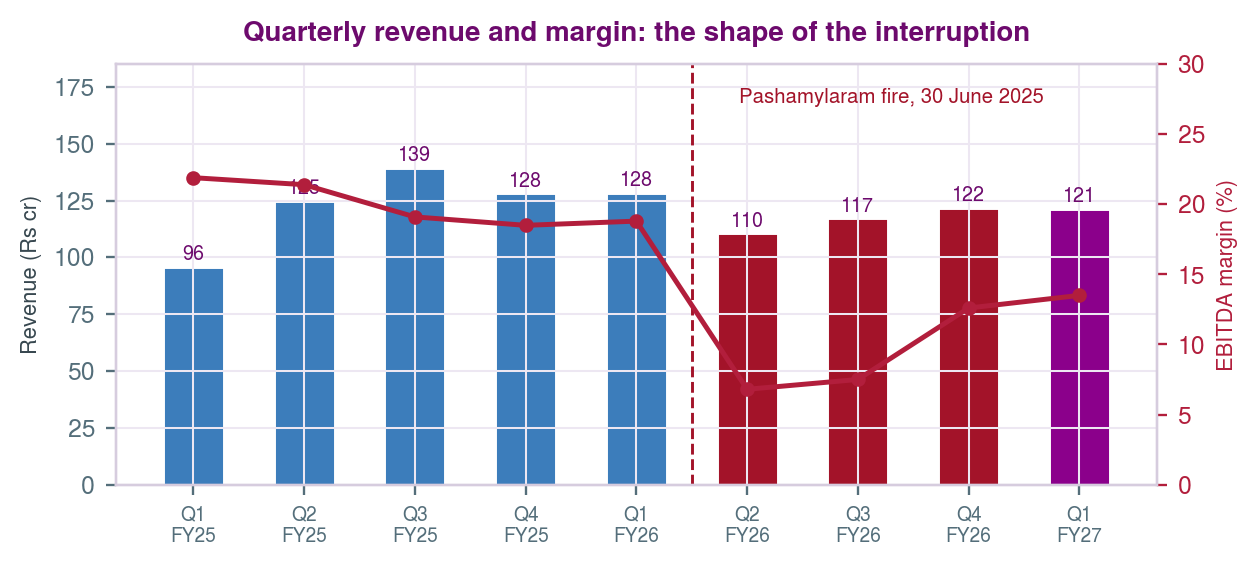
Source: Company filings and exchange disclosures. Margins are EBITDA before exceptional items.
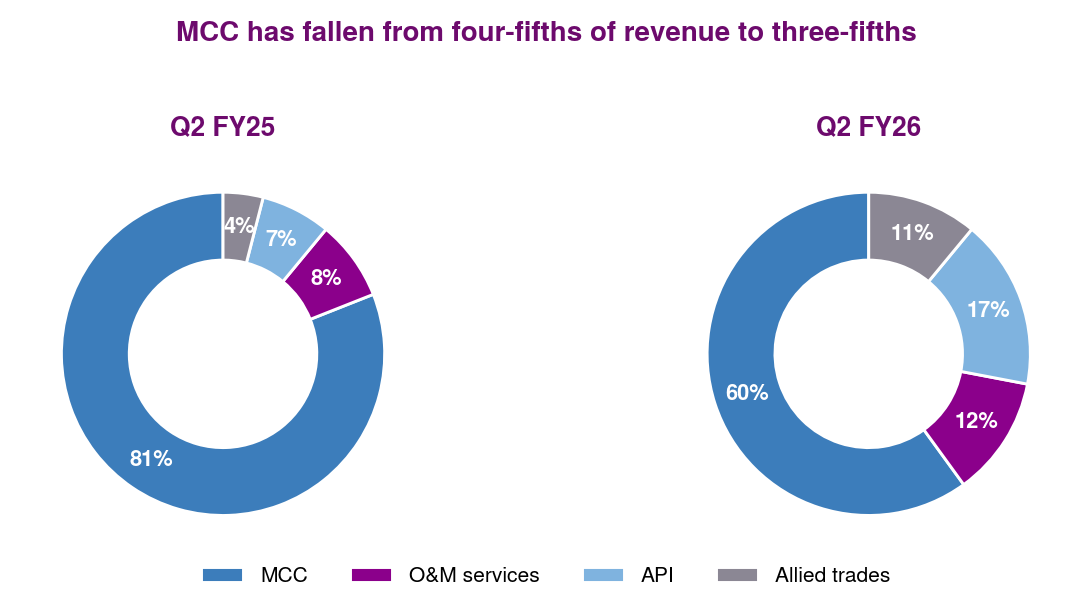
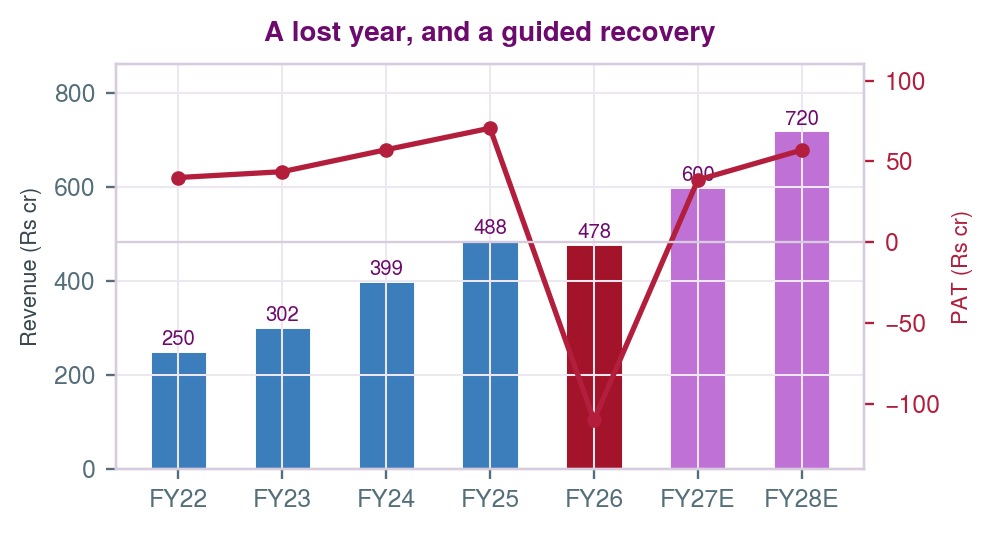
Source: Company investor presentations and filings; Dart Consultants estimates for FY27E–FY28E. Segment shares are for the September quarter of each year.
This section deals with an ongoing criminal investigation and unresolved litigation arising from an industrial accident in which many people died. We report only what has been publicly stated by the company, by government representatives in open court, or in mainstream press coverage. Nothing here has been adjudicated; all parties are entitled to the presumption of innocence. We include it because it is material to the security, not to apportion blame.
Unlike Accent, Sigachi is listed on the main boards of the NSE and BSE (November 2021), so the full corporate governance chapter of the Listing Regulations — Regulations 17 to 27 — applies without exemption. On the formal architecture the company complies, though generally at the regulatory minimum rather than above.
The board comprises six directors: three executive — a Whole-Time Director and Chairman, a Whole-Time Director and Vice-Chairman, and the Managing Director and Chief Executive Officer — and three non-executive independent directors, two of whom are women. Independent directors therefore constitute exactly 50% of the board, which is the minimum Regulation 17 requires where the chairperson is an executive director. The Audit Committee is chaired by an independent director with a second independent director as a member and the MD and CEO as the third, giving the two-thirds independent composition Regulation 18 requires — again, exactly. The Nomination and Remuneration Committee is composed entirely of independent directors, which exceeds the requirement.
Committee independence where it counts. Both the Audit Committee and the NRC are chaired by independent directors, and the NRC is fully independent.
A functioning insider-trading process. Ahead of the 22 August 2026 board meeting on the preferential issue, the Company Secretary notified a trading-window closure from 19 August until 48 hours after the meeting, covering designated persons, immediate relatives and connected persons. Routine, but evidence that the code operates.
Encumbrance transparency. A Regulation 31(4) disclosure filed on 6 April 2026 confirmed that promoters and persons acting in concert created no new encumbrances on their holding during FY26 beyond those already disclosed.
External monitoring of issue proceeds. CARE Ratings has been appointed as monitoring agency for the proposed preferential issue — a genuine external check, and a practice the company also used for its 2023 warrant issue.
Internal audit upgraded. The board changed internal auditors to RSM Astute Consulting in August 2026, an established firm. After the events of FY26 this is the right direction of travel.
Prompt quantification of the loss. The company disclosed and quantified the exceptional charge of approximately Rs 121 crore in its Q1 FY27 filings rather than deferring recognition.
Compliance sits at the line, not above it. Independent representation of exactly 50% and audit committee independence of exactly two-thirds leave no headroom: a single independent resignation would put the company out of compliance until replaced. For a company carrying the risk profile described below, we would expect a board with more independent capacity, not less.
Promoter holding of roughly 36.7% is low for a company undertaking a large capital programme. It reduces alignment and simultaneously creates an incentive to rebuild stake through preferential issues to insiders — which is precisely what is now proposed.
Slow deployment of issue proceeds. Approximately Rs 32.3 crore of IPO proceeds earmarked for the croscarmellose sodium project remained unutilised as at 30 June 2026 — close to five years after the November 2021 listing.
The 2023 warrant issue was not honoured in full. The June 2023 preferential allotment of up to 1.10 crore convertible warrants at Rs 261 each, aggregating roughly Rs 287 crore, was intended to include substantial promoter and KMP subscription. On the Q3 FY26 earnings call management was questioned about a reported shortfall of approximately Rs 68.6 crore from warrant holders and around Rs 56.8 crore in promoter investment commitments, with the associated amounts forfeited. Insiders declining to convert warrants they applied for is a signal about their own conviction, and it left the company short of planned capital.
An unusually low effective tax rate is flagged by screening services. This is not an accusation — there may be a straightforward explanation in export incentives or unit-level exemptions — but it is a line an investor should reconcile from the notes rather than assume away.
4.1 A fatal industrial accident, with criminal proceedings naming the chief executive. On 30 June 2025 a blast and fire destroyed part of the Pashamylaram unit in Sangareddy district, Telangana. The company initially reported the loss of 40 employees and more than 33 injured; figures placed before the Telangana High Court in December 2025 put the toll at 54 dead, 8 missing and 28 seriously injured. Sangareddy police registered a first information report under Sections 105, 110 and 117 of the Bharatiya Nyaya Sanhita; the state government registered a case of culpable homicide against the management and constituted a five-member investigation committee, with the Labour, Employment, Training and Factories department separately examining the deployment of unskilled workers in hazardous operations. At a hearing on 31 December 2025, the state's Additional Advocate General informed the High Court that the Managing Director and Chief Executive Officer, Mr Amit Raj Sinha, had been arrested, that five other accused remained absconding, that the investigation was in its final stage and that a chargesheet would be filed. A public interest litigation seeking an independent probe is pending. Mr Sinha remains Managing Director and Chief Executive Officer and is the principal proposed subscriber to the August 2026 preferential issue.
4.2 A public gap between announced and admitted compensation. The company publicly committed to ex-gratia compensation of Rs 1 crore per deceased worker. In an affidavit before the Telangana High Court it subsequently stated that its own liability was limited to Rs 42 lakh per worker — a figure inclusive of provident fund, ESI, insurance proceeds and funeral expenses — with the remaining Rs 58 lakh to be paid by the state government under a 1 July agreement, and that amounts between Rs 5 lakh and Rs 30 lakh had been disbursed in instalments with post-dated cheques covering the balance. As at December 2025 roughly Rs 22 crore had been disbursed in total. The company's legal position may well be correct. The distance between a press announcement and a court affidavit is nonetheless the kind of disclosure-quality question that damages credibility with the regulated-market customers whose audit their suppliers on environment, health and safety.
4.3 Reported absence of a fire department no-objection certificate at the affected unit was carried in mainstream press coverage in the days after the incident. We have not independently verified it and the company has not, to our knowledge, addressed it publicly.
4.4 A large, deeply discounted preferential issue to the promoter, pending approval. On 22 August 2026 the board approved a preferential allotment of up to 11 crore convertible warrants at Rs 26.40 each, aggregating approximately Rs 290 crore, alongside an increase in authorised share capital from Rs 43 crore to Rs 60 crore. Of these, 7.5 crore warrants are earmarked for promoter Mr Amit Raj Sinha and 3.5 crore for 42 other identified allottees. Each warrant converts into one equity share within 18 months. On full conversion the promoter group would hold 43.73% and the public 56.27%. An extraordinary general meeting was convened for 15 September 2026.
Three observations. Against approximately 38.2 crore shares outstanding, full conversion represents roughly 29% dilution. The Rs 26.40 price is about 30% below the Rs 37.60 market price at our reference date; SEBI's ICDR pricing formula is based on volume-weighted averages over preceding periods, so a discount to spot is not by itself improper, but the size of the gap matters to existing holders. And the 2023 precedent — insiders subscribing and then not converting — means the capital cannot be assumed to arrive simply because the resolution passes.
The outcome of the 15 September 2026 EGM, and then the actual subscription and conversion of the warrants — not merely their allotment. The chargesheet, whether charges are framed, and the position and availability of the Managing Director and Chief Executive Officer. Further Telangana High Court directions on compensation, and the final quantum the company bears. Restart status, fire-department certification and any independently audited safety review at the affected site — and whether the company publishes it. Insurance recovery against the Rs 121 crore exceptional charge, and the accounting treatment of any receipt. Deployment of the residual Rs 32.3 crore of IPO proceeds, and the monitoring agency's reports on the new issue. Whether the board adds independent capacity above the 50% minimum, and whether a dedicated safety, health and environment committee is constituted with independent oversight.
Formally compliant, substantively strained. The committee architecture is correct and independently chaired, disclosure of the financial loss was prompt, promoter encumbrance is transparent and the internal audit function has been upgraded. Those are real positives and we do not discount them.
But compliance sits at the regulatory minimum at precisely the moment the company needs more than the minimum. The chief executive is personally named in criminal proceedings arising from the company's own operations; the compensation position taken in court diverges from the position announced publicly; a prior insider warrant subscription was left unconverted; and a fresh issue would hand roughly 29% dilution to existing holders at a 30% discount, with the largest single allocation going to that same chief executive.
Governance is not a side consideration in this case. It is the principal reason our rating on the shares has moved, and it belongs in the discount rate rather than in a footnote.
| Basis | FY28E | Mult. | Value |
|---|---|---|---|
| Undiluted EPS | PAT 57 · 38.2 cr sh | 1.49 | |
| Diluted EPS | PAT ~64 · 49.2 cr sh | 1.30 | |
| Earnings — bear | EPS 1.30 | 18x | 23 |
| Earnings — base | EPS 1.30 | 24x | 31 |
| Earnings — bull | EPS 1.30 | 30x | 39 |
| Target price | 31 | ||
| CMP | 37.6 | ||
| Implied downside | (18%) |
Source: Dart Consultants estimates. Diluted share count assumes full conversion of the proposed 11 crore warrants; diluted PAT adds an estimated post-tax interest saving from deploying part of the proceeds against debt. The base multiple is set below the undiluted case to reflect the governance overhang.
The operating recovery is real and visible quarter by quarter, and we do not dispute it. But the share price has already paid for a full normalisation, a 29% dilution at a 30% discount is pending shareholder approval, and the criminal file arising from the June 2025 incident is unresolved with the chief executive personally named. On fully diluted FY28 earnings and a multiple that reflects that overhang, the shares are worth less than they trade for.
Move to HOLD on: the warrant issue completing on materially better terms, being scaled back or lapsing; two consecutive quarters at or near guided margin; or the stock de-rating toward Rs 30.
Move to BUY on: resolution of the legal file without material financial liability, together with MCC revenue share recovering toward 75% and evidence that lost customers have returned rather than been replaced by lower-specification volume.
This rating reflects information available to 12 September 2026, including the 22 August 2026 board approval of the preferential issue. It is an educational assessment, not a regulated investment recommendation — see the disclaimer.
| Year to March | FY22 | FY23 | FY24 | FY25 | FY26 | FY27E | FY28E |
|---|---|---|---|---|---|---|---|
| Revenue from operations | 250 | 302 | 399 | 488 | 478 | 600 | 720 |
| Change (yoy, %) | 29.7 | 20.8 | 32.1 | 22.3 | (2.0) | 25.5 | 20.0 |
| Operating expenses | 197 | 243 | 322 | 388 | 424 | 510 | 598 |
| EBITDA | 53 | 59 | 77 | 100 | 54 | 90 | 122 |
| Margin (%) | 21.2 | 19.4 | 19.2 | 20.5 | 11.3 | 15.0 | 17.0 |
| Depreciation | 2.9 | 6.6 | 10.8 | ~20 | ~28 | 30 | 38 |
| Interest | 1.2 | 4.3 | 7.8 | ~14 | ~16 | 15 | 14 |
| Other income | 2.6 | 6.7 | 11.7 | ~18 | ~7 | 3 | 3 |
| PBT before exceptional | 51.6 | 54.5 | 69.7 | ~84 | ~17 | 48 | 73 |
| Exceptional items | — | — | — | — | (121.0) | — | — |
| Reported PAT | 40.0 | 43.6 | 57.2 | 70.5 | (110) | 38.5 | 57.0 |
| EPS (Rs) | 1.54 | 1.41 | 1.81 | 1.84 | (2.88) | 1.01 | 1.49 |
Source: Company annual reports, investor presentations, quarterly filings and CARE Ratings for FY22–FY26; Dart Consultants estimates for FY27E–FY28E. Items marked "~" are derived from disclosed aggregates rather than reported separately. FY26 is materially affected by the exceptional charge relating to the Pashamylaram incident.
| Metric | FY23 | FY24 | FY25 | FY26 / latest |
|---|---|---|---|---|
| Overall gearing (x) | 0.26 | 0.39 | ~0.40 | 0.27 |
| Interest coverage (x) | 14.5 | 10.9 | ~7.3 | — |
| Book value per share (Rs) | — | — | — | 13.6 |
| Cash and equivalents (Rs cr) | — | — | — | 64.2 |
| RoE (%) | — | — | 14.5 | 5.8 |
| RoCE (%) | — | — | — | 6.2 |
| MCC capacity (MTPA) | 14,500 | 21,000 | 21,700 | 21,700 |
| MCC production (MT) | — | 13,602 | — | — |
| Exports (Rs cr) | — | 239.7 | — | — |
| MCC share of revenue (%) | — | ~81 | 81 (Q2) | 60 (Q2 FY26) |
Source: Company annual report FY24, investor presentations, CARE Ratings press release of January 2025, and public market aggregators as at September 2026. Dashes indicate not separately disclosed. As with Accent, we have restricted this table to sourced or directly derivable figures rather than modelling a full balance sheet.
| 12-month target | Rs 31 |
| CMP (10 Sep 2026) | Rs 37.6 |
| Potential downside | (18%) |
| Rating | SELL (initiating) |
| NSE / BSE | SIGACHI / 543389 |
| Sector | Pharma inputs / excipients |
| Shares o/s (mn) | 382.1 |
| Market cap (Rs cr) | 1,435 |
| 52-week high / low | Rs 46.7 / 16.7 |
| Book value/share | Rs 13.6 |
| Promoters | 36.7 |
| FII | 1.3 |
| DII | 0.0 |
| Public and others | 62.0 |
| FY25 | FY26 | FY27E | |
|---|---|---|---|
| Revenue | 488 | 478 | 600 |
| EBITDA | 100 | 54 | 90 |
| Reported PAT | 70.5 | (110) | 38.5 |