
Dense, smooth particles
Same chemistry. Poor compaction: few contact points, low bonding area, soft tablets that cap and crumble.
→ sells as cellulose powder
Solving for chemistry is a recipe problem. Solving for particle architecture is a process-control problem. Recipes are easy; control is subtle. This asymmetry is the single most important thing to understand about the economics of the industry — it explains who earns what, who competes with whom, and why the whole sector is racing "up the grade ladder."
The hydrolysis step that turns pulp into microcrystalline cellulose is mature and mechanical. Acid strength, temperature and residence time determine the degree of polymerisation; hit the window and you have MCC. There is no ongoing cleverness required and nothing proprietary to protect. A bigger reactor is not a harder reactor, just a bigger one.
If particle engineering were solved by choosing a target size, every producer would sell an identical product — and they visibly do not. Three properties make it fundamentally harder:
Same chemistry. Poor compaction: few contact points, low bonding area, soft tablets that cap and crumble.
→ sells as cellulose powder
Same chemistry. Excellent compaction: high surface area, mechanical interlock, hard tablets at low compression force.
→ sells as pharmaceutical MCC, at a multiple
Figure 3.1 — Identical chemistry, different products. Dense, smooth particles make weak tablets; porous, irregular agglomerates interlock and bond over a large contact area. The entire price difference between a technical powder and a pharmaceutical grade is created in the dryer, not the reactor.
In a technical cellulose powder, the pulp bill dominates and there is little else. In an engineered, co-processed pharmaceutical excipient, the raw material shrinks to a fifth of the cost and the conversion process, the analytics, and the regulatory dossier become the dominant items. This maps directly onto the company analysis later: the players who reached the top of the ladder did so by mastering particles and paperwork, not by making better cellulose.
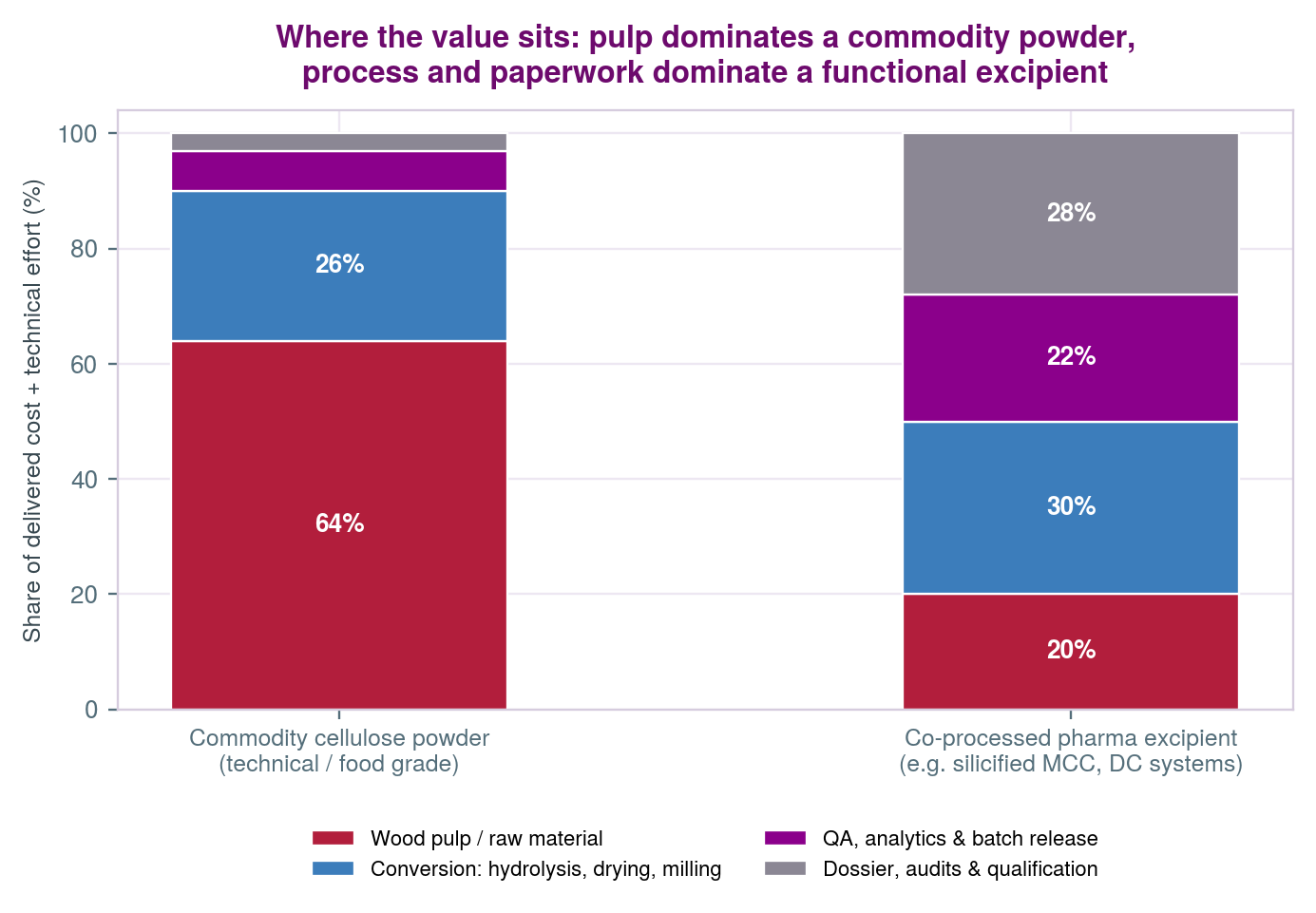
Nothing makes the point better than the grade table itself. The numbers below are the industry's common shorthand, and the chemistry is identical down every column. What differs is particle size, density and moisture — and those differences decide the application and the price.
| Grade shorthand | Typical mean particle size | What it is for | Why it costs what it costs |
|---|---|---|---|
| PH-101 | ~50 µm | Wet granulation; the default workhorse | Baseline pharmaceutical grade |
| PH-102 | ~100 µm | Direct compression; better flow | Coarser agglomerate, tighter control |
| PH-200 | ~180 µm | High-speed direct compression | Flow at the limit of what MCC can give |
| PH-105 | ~20 µm | Fine filler for low-dose blends | Fines are hard to make and harder to handle |
| PH-112 / low-moisture | ~100 µm, <1.5% water | Moisture-sensitive APIs | Extra drying, tighter packaging, niche volume |
| PH-302 / high-density | ~100 µm, high bulk density | Small tablets, high fill weight | Density is set in the dryer, not the mill |
Table 3.1 — Grades of one material. Every row is chemically microcrystalline cellulose complying with the same pharmacopoeial monograph. The grade numbering originated with the first commercial producer and became the industry's common language; competitors sell "102-equivalent" material against it. Figures are typical industry reference values, not any one supplier's specification.
When you later read that a producer is "adding premium grades" or "commissioning a spray-drying line," this table is why it matters. Moving from selling PH-101 to selling PH-200, low-moisture and co-processed material is not a volume story — it is the same tonnes sold at a higher realisation, to customers who are much harder to win and much slower to leave.