Two naming systems get mixed together in this industry, which is a common source of confusion. Once untangled, the grade classes reveal the sector's central commercial fact: as you climb the grade ladder, difficulty, barriers to entry and margins all rise together.
Paper, welding rods, ceramics · Bakery, dairy, clean-label · Generic tablets & capsules · Low-moisture, high-density, fine grades · CCS, SSG, CMC, HPMC · SMCC, MCC-lactose, DC blends
Figure 5.1 — The grade spectrum. Moving left to right, the chemistry barely changes; the particle architecture, the documentation burden and the customer's cost of switching all rise sharply. Chemically, most of this bar is the same material. Commercially, the right-hand end sells for several times the left.
The first system is compendial. A pharmacopoeia — the United States Pharmacopeia– National Formulary (USP-NF), the European Pharmacopoeia (Ph. Eur.), the Japanese Pharmacopoeia (JP), the Indian Pharmacopoeia (IP) — publishes a monograph defining the minimum identity, purity and assay requirements for "Cellulose, Microcrystalline." Meeting a monograph is binary: you either comply or you cannot sell into that market. Crucially, monographs say very little about particle size, density or compactability — the properties the customer actually cares about.
The second system is commercial. The grade numbers — 101, 102, 105, 112, 200, 302 — were introduced by the first large commercial producer and became the industry's lingua franca. Every competitor now sells material described as "102-equivalent" or "200-type." So the market talks in one company's private product codes, layered on top of a public quality floor that does not describe the product. The key overlap: the monograph is a licence to compete; the grade number is the actual specification, and the gap between the two is where all the differentiation lives.
As you climb, the process lengthens, the analytics multiply, the batch sizes shrink and the customer base narrows. Standard grades are sold in tonnes to hundreds of buyers. Co-processed systems are sold in hundreds of kilograms to dozens of buyers, each of whom has written the product into a regulatory filing. Value per tonne and margin both rise — because higher-grade product is technically harder and sold to fewer, more demanding, more committed buyers.
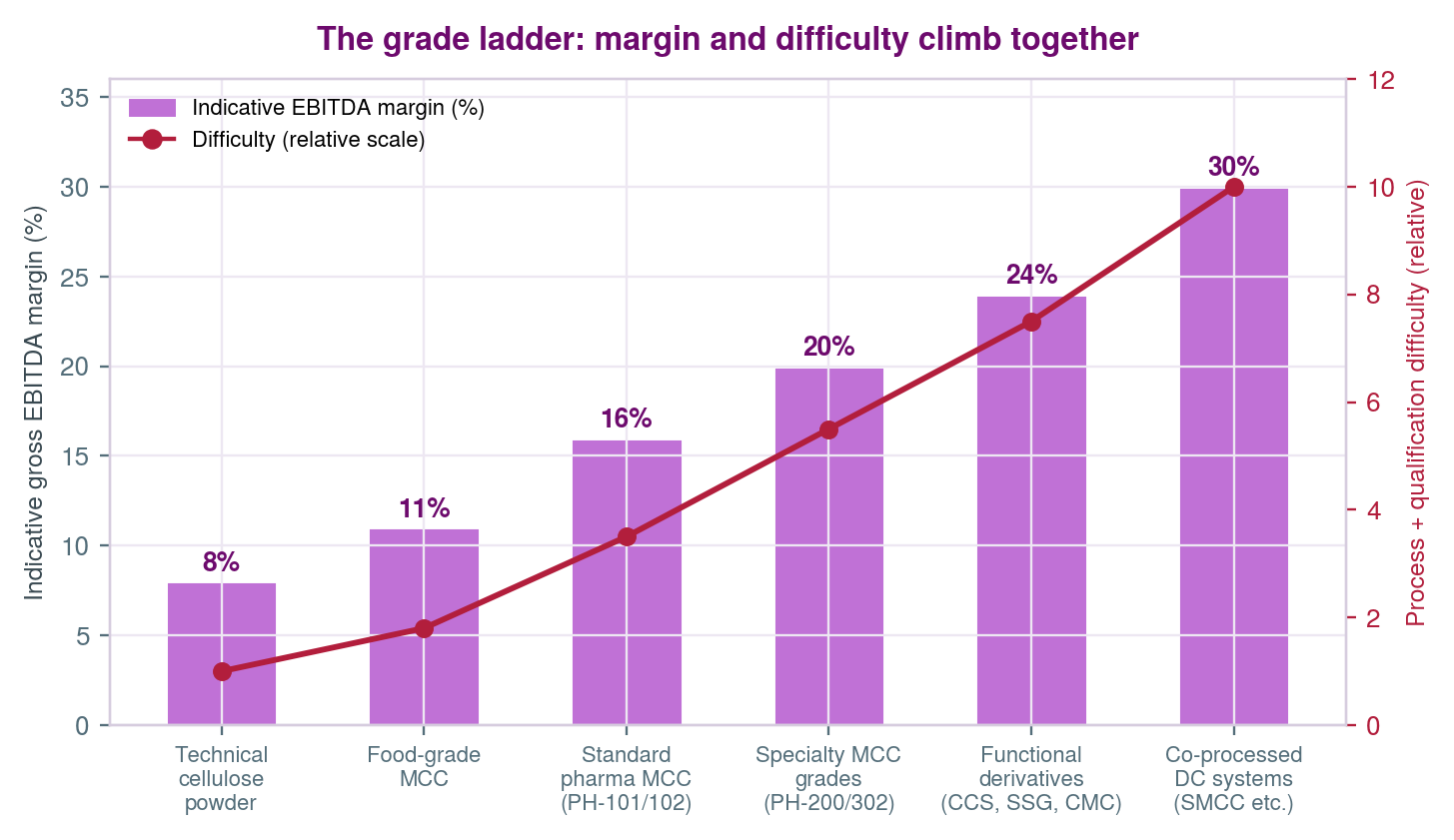
Every serious player in this industry is trying to climb up this ladder — from technical and food-grade powder toward pharmaceutical grades, functional derivatives and co-processed systems — because that is where difficulty protects margin from competition. When you read the company section, watch for this single move repeating: everyone is climbing the grade ladder, and the ones who cannot are being squeezed against the pulp price on one side and the customer's purchasing department on the other.
One product family breaks the clean "one material, one monograph" logic. A co-processed excipient is two or more existing excipients physically combined during manufacture — silicified microcrystalline cellulose, for example, in which MCC is spray-dried together with colloidal silicon dioxide, or the MCC–lactose systems sold for continuous direct compression.
It is not a new chemical entity: every component is already an approved excipient, so there is no toxicology programme and no new-substance approval. But it is also not simply a blend, because the co-processing changes the particle surface and delivers performance that a physical mixture of the same two ingredients does not. For years this left the category in a genuine regulatory grey zone — it sits between "mixture" and "material," and the pharmacopoeias have only gradually built standards for it. That ambiguity is precisely why it is profitable: the performance is patentable or protectable as know-how, the regulatory path is short, and the barrier to a commodity producer copying it is a spray dryer plus a decade of formulation credibility.
| Product | What it is | Regulatory path | Switchable? | Class |
|---|---|---|---|---|
| Cellulose powder (technical) | Milled pulp, no hydrolysis | None required | Freely | Commodity |
| MCC (monograph grade) | Hydrolysed, dried, milled | Monograph + DMF | With re-qualification | Pharmaceutical |
| Functional derivative (CCS, SSG, CMC) | Chemically modified cellulose | Own monograph + DMF | Rarely, slowly | Specialty |
| Co-processed system (e.g. SMCC) | Two approved excipients, processed together | Components approved; system filed as used | Effectively not | Engineered |
Table 5.1 — The dividing line is documentation and switchability, not chemistry. "Higher grade = harder to make" holds in practice, but the more useful test is: how expensive would it be for the customer to replace you? The co-processed system is the extreme case — replacing it is a reformulation.
Barriers in this industry are not built from patents. Almost nothing here is patented. They are built from the customer's cost of change. That cost rises steeply with grade, and it is the only durable moat in a business whose core chemistry expired before most of its customers were born.
Everything discussed so far — the vocabulary, the two problems, the grade ladder — now comes together as physical products. This is the entire product universe of the sub-sector in two pictures. Spend a moment here: once you can place these on the ladder, every company in the report becomes legible as "the firm that makes these products."
These are all cellulose. They differ in how far they have been processed away from wood pulp and how tightly the resulting particle is specified. This is the axis Accent Microcell, Sigachi and Chemfield all compete along.
Ground pulp, no hydrolysis
Technical / food · lowest value
PH-101 / PH-102 · wet-granulation grade
The industry workhorse
PH-200 / PH-302 · flow and density tuned
Direct-compression premium
MCC co-processed with colloidal silica
Higher compactability · co-processed
Cross-linked CMC · superdisintegrant
Swells 4–8x · functional derivative
Soluble ethers · binder, thickener, matrix
Controlled release · highest spec
Figure 5.3 — The cellulosic family. From ground pulp, through the standard and spray-dried MCC grades, to the co-processed and chemically modified derivatives at the top of the ladder. The visual difference between the tiles is the particle; the commercial difference is a multiple.
The second axis is role. A formulation is a team of materials, and a supplier's breadth across these roles determines whether it sells a product or a solution. Note that the highest-value roles — release modification and coating systems — are dominated by chemically modified cellulose ethers and polymers, which is the direction every cellulosic producer eventually tries to move in.
MCC, lactose, mannitol, starch
~35% of excipient value
HPMC, povidone, pregelatinised starch
Holds the compact together
CCS, sodium starch glycolate, crospovidone
Breaks it apart again
Magnesium stearate, colloidal silica
Machinability, not medicine
HPMC films, pigments, plasticisers
Taste, moisture, appearance
High-viscosity HPMC, polymer matrices
The excipient that acts like a drug
Figure 5.4 — The functional family. Fillers carry the tonnage; disintegrants and release modifiers carry the margin. A producer that only makes fillers is a volume business; one that spans roles becomes a formulation partner.
Every product in this industry sits somewhere in these two galleries. When you read a company profile, map it back here: Accent Microcell lives in the first three tiles of the first gallery and is building into the fourth and fifth; Sigachi occupies the same tiles and has diversified sideways out of the gallery entirely; the global majors own the bottom-right of both. The whole competitive map is just "who occupies which tiles, and who is trying to move rightward."