A natural question: if particle engineering is so valuable, why does anyone still buy the cheap grades? The answer reframes the whole industry — because for most of pharmaceutical history, the formulator did the particle engineering themselves, in their own plant, for free.
Figure 4.1 — The two process routes. Wet granulation builds the granule in the customer's factory using water, heat and time. Direct compression deletes those steps — which means the particle must arrive from the supplier already built. Shaded (highlighted) steps are the ones direct compression removes.
In wet granulation the formulator wets the powder blend with a binder solution, agglomerates it, dries it, and mills it to size. What emerges is a granule with good flow and good compaction — manufactured in-house, out of whatever cheap powder went in. The formulator has performed, with their own equipment, exactly the transformation that a spray-drying line performs. So the incoming excipient can be ordinary: any monograph-compliant MCC will do.
This is the same structural trade that appears in every industry with a "make or buy" step in the middle. Where the customer has the equipment, the time and the tolerance for four extra unit operations, they will do the work themselves and buy the cheap input. Where they do not, they must purchase the finished property.
Wet granulation is expensive in ways that do not appear on the excipient invoice. It adds four unit operations, a drying step with its energy bill, a validated cleaning cycle between products, significant footprint, and — critically — it exposes the API to water and heat. Many modern molecules, and nearly all biologically derived ones, do not tolerate that. Continuous manufacturing, which regulators have actively encouraged, is also far easier to implement without a wet step.
So the industry keeps drifting toward direct compression: blend, lubricate, compress, coat. Fewer steps, less equipment, no water. And the moment you delete the granulator, the compressibility has to come from somewhere — so you buy it, in the form of a premium grade or a co-processed system, at roughly two to three times the price per kilogram.
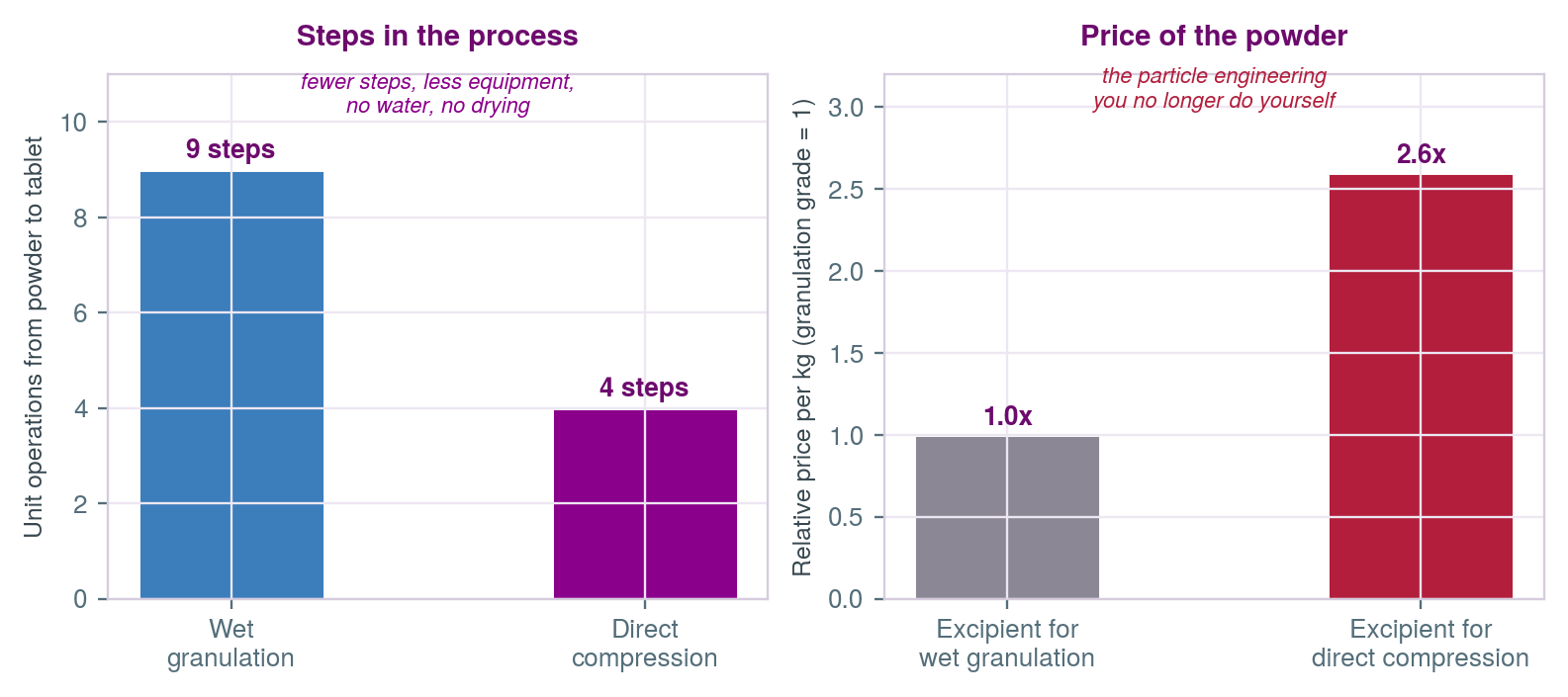
Cheap excipients are not "worse" excipients. They are excipients sold to a customer who is still doing the particle engineering themselves. The premium grade is not a better molecule — it is the customer's granulation step, pre-performed and sold in a bag.
This single idea explains why the same material spans a wide price range, why the market keeps migrating toward the expensive end without anyone deciding to pay more, and why a producer's position on the grade ladder is really a statement about how much of the customer's process it has absorbed.
Wet granulation still accounts for a large share of installed capacity, particularly in high-volume generic manufacture in India and China where the equipment is long since depreciated and labour is cheap. That installed base is the reason a durable market for standard-grade MCC exists at all, and it is not going away quickly. But it is not where new lines are being built.
The direction of travel matters more than the current split. Every new plant designed for continuous processing, every moisture-sensitive molecule, every attempt to shorten a validation cycle pushes a formulation toward direct compression — and every one of those decisions permanently upgrades the specification of the excipient that formulation will buy for the rest of its commercial life. Demand mix, once shifted, does not shift back: the granulator has been sold.
A producer selling only standard grades is exposed to a stable but structurally shrinking share of the market, competing on price against everyone. A producer with spray-dried, low-moisture and co-processed capability is selling into the growing share, competing against a handful of firms, and is embedded in a formulation that would need to be re-qualified to replace. The capital difference between those two positions is a dryer. The commercial difference is the whole business.