Pure-play · high spec
- Accent Microcell — MCC pure-play
With the science and the numbers established, the companies now read as consequences rather than a list to memorise. Each one is defined by where it sits on two axes: how far up the grade ladder it reaches, and whether it is an independent specialist or a division of a larger chemical or pulp platform. That second axis turns out to matter more in this industry than in most.
Figure 9.1 — The positioning map. Note the structure: the independent pure-plays cluster on the left, and almost every producer at the top of the ladder sits inside a larger group — because the capital and patience required to build formulation-science credibility are easier to fund from a platform. The Indian names occupy the independent, cellulose-only, climbing column; everyone at the top of the ladder on the right reached it inside a bigger chemical or pulp platform.
India has two listed companies for which cellulosic excipients are the core business: Accent Microcell and Sigachi Industries. They began from a similar place and have taken visibly different paths — one narrowing and deepening, one broadening — and the last three years have provided an unusually clean natural experiment in which strategy this industry rewards.
Identity. Accent Microcell is an Ahmedabad-based manufacturer of microcrystalline cellulose and related excipient powders. It began as a partnership firm in 2002, incorporated in 2012, and listed on the NSE Emerge SME platform in December 2023, raising Rs 78.4 crore. The promoter group — the Patel family — has roughly two decades of experience in cellulose powders. In the language of this report, Accent lives almost entirely in the "particle" business and is now spending capital to move into the "derivative" tile beside it.
Products and plants. The core range is standard and spray-dried MCC, extending into silicified MCC, croscarmellose sodium and carboxymethyl cellulose, sold under the company's own brand names. It operates two plants in Gujarat — Pirana, near Ahmedabad, established in 2012, and a Dahej Special Economic Zone unit commissioned in FY15 — with combined installed capacity of about 9,200 MTPA. Facilities carry ISO 9001, FSSC 22000, GMP and HACCP certification, and key products are covered by a US Drug Master File along with Kosher and Halal certification.
Financial character. FY26 total income rose about 31% to Rs 355.8 crore with profit after tax of Rs 43.9 crore, earnings per share of Rs 18.65 and a final dividend of Re 1. Operating margin on a PBILDT basis was 16.0% in FY25 and improved to 17.8% in the first half of FY26. The balance sheet is the strongest feature: gearing of 0.01x, interest cover above sixty times, working-capital limit utilisation around a tenth, and a net worth that crossed Rs 250 crore after a Rs 39.8 crore rights issue in June 2025. CARE Ratings upgraded the company to A–/Stable and A2+ in March 2026.
The capacity story — and the wrinkle inside it. Accent sold roughly 15,000 metric tonnes in FY26 against 9,200 MTPA of installed capacity, with approximately 70% manufactured and 30% traded. Read that carefully: the company is running its own plants hard and buying in material to serve demand it cannot make. That is why Unit-III at Nayka in Kheda district matters so much. Its first phase adds roughly 2,400 MTPA of higher-value derivatives — croscarmellose sodium, sodium starch glycolate and CMC — and the second phase adds around 12,000 MTPA of MCC, taking total capacity toward 24,000 MTPA for a combined outlay in the region of Rs 105–110 crore.
The execution risk, stated plainly. Unit-III has slipped repeatedly. Commercial production was originally indicated for October 2025, then April 2026, and the company subsequently notified the exchange of further delay, citing two abnormal monsoon seasons and difficulty obtaining environmental clearance and power transmission approvals, without giving a revised date. In August 2026 it ordered a 4.45 MW captive wind turbine to serve all three plants — a sensible move on energy cost, and also a signal that Unit-III is being planned for as a live project. But the investment case rests on that plant producing, and it has not yet done so.
A focused, debt-free, export-led cellulosics producer that has compounded revenue at a mid-to-high teens rate without leverage, is capacity-constrained enough to buy in a third of its volume, and is spending a year's profit to add derivative capability it cannot yet sell. The quality of the business is not in dispute. The timing of the step-up is.
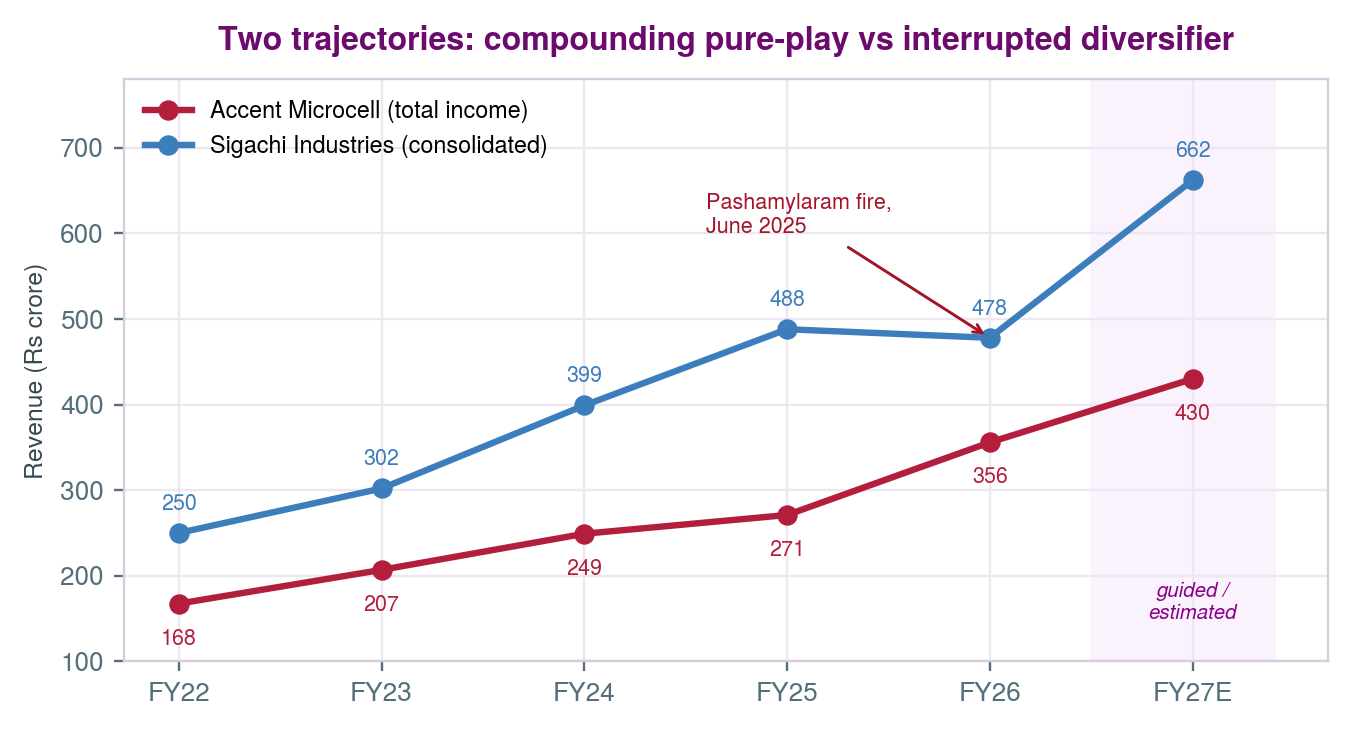
Identity. Incorporated in 1989 and listed in November 2021, Sigachi is the larger of the two Indian pure-plays by revenue and by MCC capacity, with plants in Telangana and Gujarat. Through FY25 it was the sector's growth story: revenue compounded from roughly Rs 250 crore in FY22 to Rs 488 crore in FY25 at consistently ~20% operating margins, supported by a 7,200 MTPA capacity addition at Dahej and Jhagadia and by exports running around 60% of sales.
The diversification. Sigachi has deliberately broadened beyond cellulosics: an active pharmaceutical ingredient business built partly through acquisition, an operations-and-management services arm, and allied trading. By the second quarter of FY26 the revenue mix had moved to roughly 60% MCC, 17% API, 12% services and 11% allied trades, against 81% MCC a year earlier. Management has since pointed to a complex fluorinated API portfolio with potential annual revenue of around Rs 250 crore from the fourth quarter of FY27. In the framework of this report, this is a company that chose to broaden across industries rather than climb within one.
The incident. On 30 June 2025 a fire and blast destroyed part of the Pashamylaram unit near Hyderabad, causing multiple fatalities. It was a human tragedy first and a financial event second. The company booked an exceptional loss of about Rs 121 crore in the first quarter of FY26, shifted MCC production to Dahej and Jhagadia, disbursed compensation, and began a phased rebuild. FY26 revenue finished at Rs 478 crore — down about 2% — with operating margin roughly halved to 11% and a consolidated net loss of around Rs 110 crore after the exceptional item. The fourth quarter showed the beginnings of normalisation: Rs 121.9 crore of revenue, a 12.6% EBITDA margin and Rs 7.6 crore of profit.
What Section 7 predicted. The qualification clock cuts both ways, and Sigachi is the case study. A customer whose supply is interrupted must qualify an alternative source — and once that work is done, the switching cost that used to protect the incumbent now protects the replacement. Recovering lost tonnage is therefore slower than rebuilding the plant. This is visible in the FY27 guidance of Rs 650–675 crore with an 18–20% EBITDA margin: credible as an ambition, but dependent on both a 12,000 MT expansion landing late in the year and on customers returning.
The governance flags. Analysts on the third-quarter FY26 call pressed management on a reported shortfall of roughly Rs 68.6 crore from warrant holders and around Rs 56.8 crore in promoter investment commitments. Promoter holding stands near 36.7%. Screening services flag a low effective tax rate. None of these is dispositive on its own; together they argue for a higher required return than the operating numbers alone would suggest.
The scale leader that left the niche. It has the largest Indian MCC capacity and a real export franchise, but it diluted a high-quality single-product business with lower-quality adjacencies, and then absorbed an operational catastrophe that cost it a year and an unknown amount of qualified customer base. The recovery is plausible. It is not yet demonstrated.
A beginner's natural intuition is that the larger producer, with more capacity and more product lines, should earn the better margin. The data says otherwise, and understanding why is the key to the whole competitive picture.
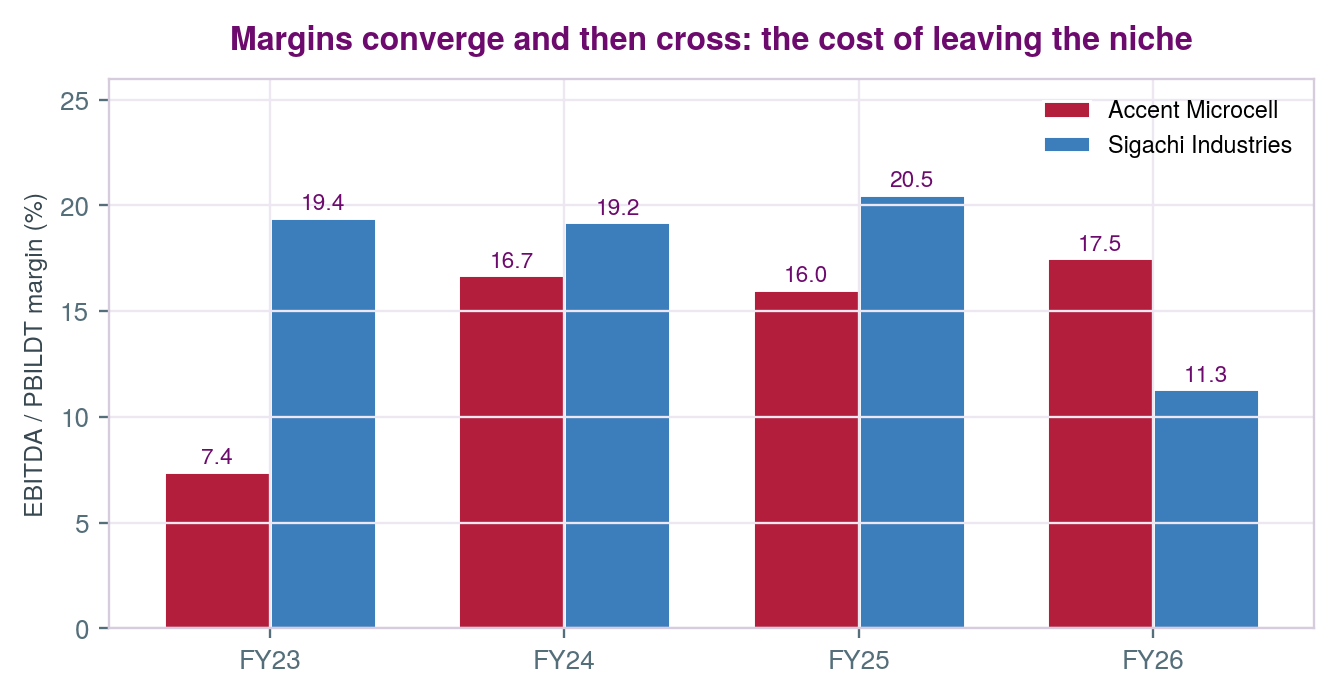
The resolution is that in this industry margin comes from grade mix and qualification depth, not from scale. Tonnage buys purchasing power on pulp, which is a small and shared advantage. Grade mix buys realisation per tonne, which is not shared at all. And qualification depth buys the right to keep the customer when a cheaper offer arrives. A producer that adds volume in standard grades is buying revenue at the industry's worst margin; a producer that adds a spray dryer and a derivative line is buying the industry's best.
The same logic explains the diversification trap. Moving into an adjacent industry — APIs, services, trading — adds revenue that does not benefit from the excipient moat, is competed against entirely different firms, and carries entirely different risk. It can be the right decision. But it should be recognised for what it is: leaving a defended position, not extending one.
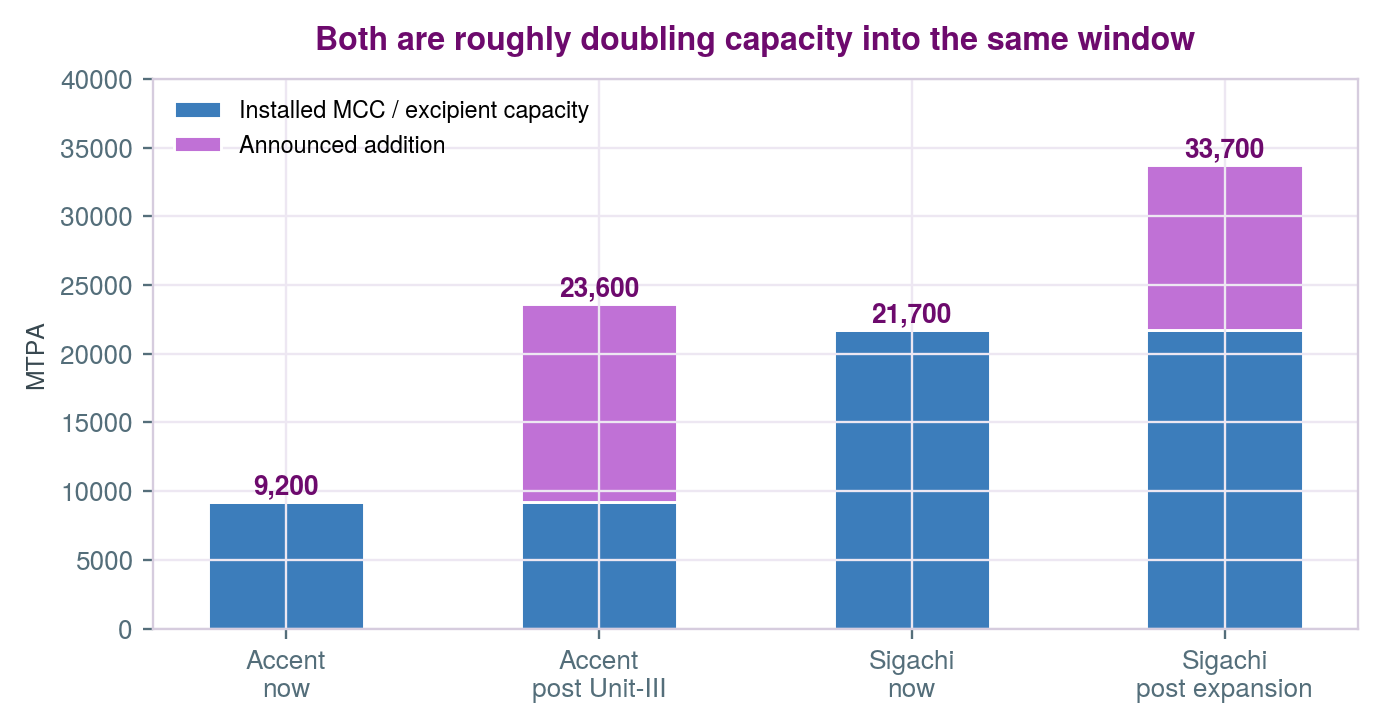
Add Accent's roughly 14,400 MTPA of new capacity to Sigachi's announced 12,000 MT and you have approximately 26,000 MTPA arriving in a global MCC market of the order of a few hundred thousand tonnes. Both companies are making the same bet at the same time, and both are funding it. The bull case requires that this capacity be absorbed by grade upgrade and export share gain. The bear case is simply that it is not, and that two well-capitalised producers compete it away.
Below and around the listed names sits a set of competitors that shape pricing without being investable in India. They matter because they illustrate the sector's patterns — and because two of them have recently changed the structure of the market.
Chemfield Cellulose is the most consequential. A well-regarded Indian MCC producer selling into European and American pharmaceutical customers, it agreed in March 2025 to a strategic stake sale to Oji Holdings, the Japanese pulp and paper group, in a transaction structured across multiple tranches. Oji described the logic explicitly: integrating its own pulp production with pharmaceutical excipient manufacture to create a "tree to tablet" chain with full traceability, and it highlighted Chemfield's positioning on the absence of carcinogenic nitrosamines.
That deal is the single most important structural event in this sub-sector in recent years, for three reasons. It converts a domestic competitor into the Indian arm of a global pulp major with a captive raw-material position. It validates the thesis that the interesting margin sits between pulp and tablet. And it signals that the strategic buyer for an Indian excipient business may be upstream rather than a pharmaceutical company.
Ankit Pulps & Boards and a long tail of smaller producers occupy the cellulose-powder and lower-grade MCC tiles. They are the reason the bottom of the ladder is permanently competitive, and they are also the most exposed to the documentation tailwind described in Section 6: as impurity expectations tighten, undocumented capacity quietly loses pharmaceutical business and falls back into food and technical grades.
At the top of the ladder sit divisions of very large groups. None is an investable pure-play; excipients are a modest line within a much larger business in every case.
| Group | Position in cellulosics / excipients | Structural advantage |
|---|---|---|
| IFF (Pharma Solutions) | Holder of the original reference MCC franchise, whose grade numbering the industry still uses | Brand incumbency and the deepest regulatory history |
| Asahi Kasei | High-compactability MCC grades aimed squarely at direct compression | Particle engineering as a differentiated product, not a specification |
| JRS Pharma | Broad cellulosics plus the leading silicified MCC co-processed franchise | Ownership of the co-processed category at the top of the ladder |
| DFE Pharma | Lactose-led filler platform with cellulosics alongside | Sells the competing filler chemistry, so wins either way |
| Roquette | Starch, polyol and cellulosic excipients from a plant-based platform | Raw-material integration and formulation-services depth |
| BASF, Ashland | Synthetic polymer excipients — povidone, crospovidone, cellulose ethers | Compete against cellulose in disintegrants and binders |
| Anhui Sunhere and Chinese producers | Large-scale MCC, price-competitive, mainly standard grades | Cost; increasingly offset by customer de-risking away from single-country supply |
Table 9.1 — The global landscape. Two corrections worth noting, because both appear frequently in secondary sources: the original Avicel MCC franchise passed from FMC to DuPont in 2017 and now sits within IFF's pharma solutions business, so FMC is no longer the relevant counterparty; and the Klucel hydroxypropylcellulose line belongs to Ashland, not to Asahi Kasei, whose cellulosic franchise is the Ceolus range.
Not symmetrically. The majors dominate the top two tiles of the ladder — co-processed systems and high-compactability branded grades — where Indian producers have little presence and are not currently competing. The Indian producers dominate the cost-competitive middle, where the majors do not wish to compete. The genuine competitive pressure on Indian producers comes from Chinese capacity below them and from each other, not from JRS or Asahi Kasei above them. The threat from above only becomes real if an Indian producer succeeds in climbing — which is precisely what both are now spending money to do.