In most industries, regulation is a cost. In this one it is the moat. Understanding exactly how an excipient becomes legally usable — and what it takes to replace one — is essential to judging whether any producer's revenue is defensible. This section works through that architecture.
Here is the fact that governs everything: an excipient has no independent regulatory approval in most major markets. Unlike an API, it is not licensed on its own. It acquires regulatory standing only as a component of an approved drug product, and the party legally responsible for proving it is suitable is not the excipient maker — it is the marketing authorisation holder, the pharmaceutical company selling the medicine.
That asymmetry has two consequences. First, the customer, not the regulator, is the real auditor: the drug company must qualify, audit and justify its excipient supplier, and carries the liability if that judgement is wrong. Second, once a supplier has been written into an approved filing, removing them is the customer's problem, not the supplier's. The incumbent is protected by the customer's own paperwork.
Cumulative elapsed time to qualify a new excipient source into an approved product: typically three to five years.
The incumbent is not protected by a patent or by cost. It is protected by the customer's unwillingness to restart that clock.
Figure 7.1 — The qualification clock. Each stage is routine on its own; in series they add up to a multi-year commitment that a purchasing department will not undertake to save a few percent on a material that is a small fraction of the cost of goods. This is why excipient revenue, once won, is unusually sticky — and why winning it in the first place is unusually slow. It is also why a plant fire, a failed audit or a supply interruption is so expensive: the customer who leaves does not come back quickly.
Several overlapping instruments make up the framework. None of them is an approval; together they constitute credibility.
| Instrument | What it is | Who issues it | What it buys the supplier |
|---|---|---|---|
| Pharmacopoeial monograph | Minimum identity and purity standard (USP-NF, Ph.Eur., JP, IP) | Pharmacopoeial authorities | A licence to compete, not a differentiator |
| Type IV DMF | Confidential process and quality dossier, referenced by customers' filings | Filed with the US FDA | Customers can cite the process without seeing it |
| IPEC-PQG GMP Guide | The industry GMP standard written specifically for excipients | IPEC and the Pharmaceutical Quality Group | A defensible definition of "GMP" for a non-API |
| NSF/IPEC/ANSI 363 | US national GMP standard for excipients | NSF / ANSI | An auditable benchmark |
| EXCiPACT certification | Third-party GMP/GDP certification scheme for excipient makers | Independent certification bodies | Replaces repeated customer audits |
| Nitrosamine risk questionnaire | Standardised impurity risk assessment, updated 2025 | IPEC Federation | Speed of response becomes a selling point |
Table 7.1 — The quality architecture. Note the pattern: almost every instrument exists to let a customer trust a supplier without re-auditing them. The commercial value of each certification is the audit it makes unnecessary.
India's pharmaceutical industry is famously dependent on imports for its inputs: roughly two-thirds to three-quarters of its active ingredient requirement is sourced from China, with near-total dependence in several fermentation-derived categories. Government policy — the production-linked incentive scheme for bulk drugs, the bulk drug parks programme — is aimed squarely at reversing that in APIs.
Excipients invert the picture. In cellulosics India is a net exporter, and the domestic market is smaller than what its own producers ship. The two listed Indian producers between them bill more than published estimates of India's entire domestic microcrystalline cellulose consumption. They are, functionally, export businesses that happen to be located in India — selling into the United States, Europe, Latin America and the Middle East against Chinese, Japanese, European and American competitors.
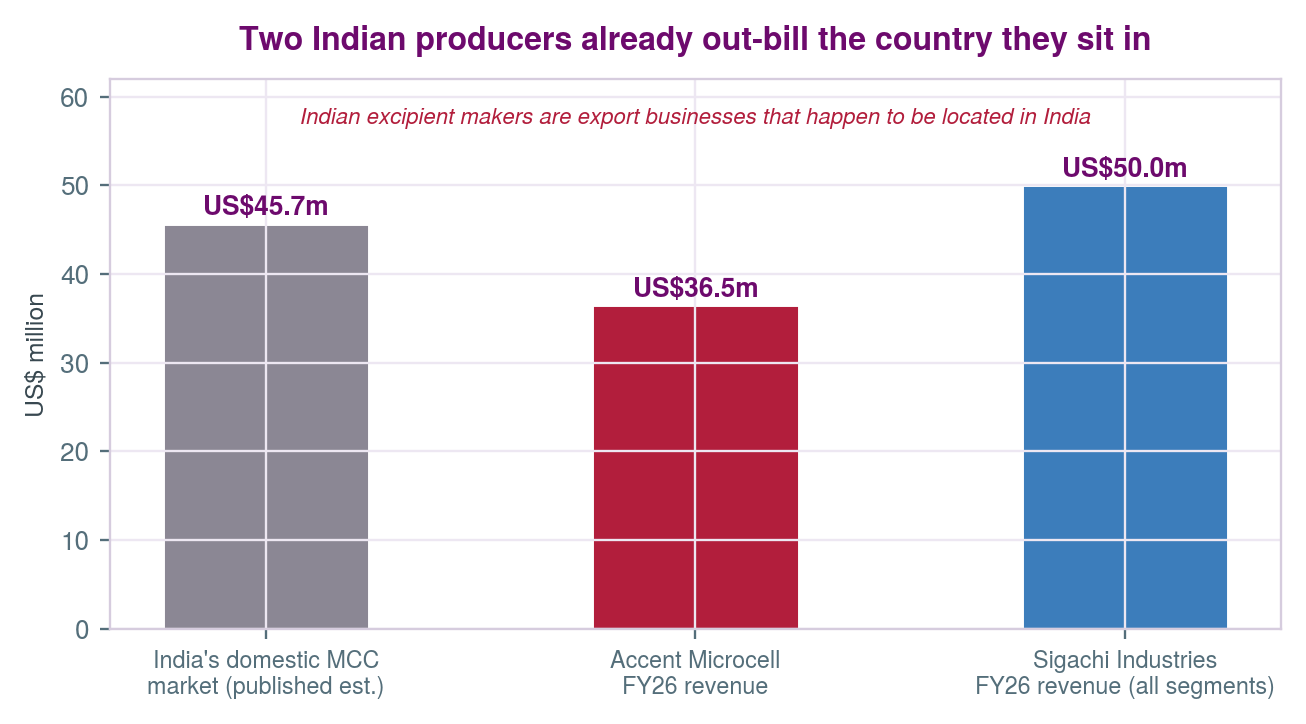
Two things follow. First, there is no policy subsidy tailwind here — the incentive schemes target APIs and key starting materials, not excipients. Whatever these companies earn, they earn commercially. Second, their fortunes are tied to global qualification cycles and the dollar, not to Indian pharmaceutical spending growth. An investor who models these businesses off Indian pharmaceutical formulation growth is modelling the wrong variable.
Barrier height: high and rising — three to five years to qualify a new excipient source into an approved product, and impurity scrutiny keeps tightening.
Barrier type: not patents, not scale, not cost. The barrier is the customer's unwillingness to restart a validation clock for a material that is a small share of their cost of goods.
The vulnerability this creates: the same mechanism that protects an incumbent punishes any interruption. A plant fire, a failed audit, or a supply failure forces the customer through the qualification process anyway — and once they have gone through it with someone else, the switching cost now protects your competitor. In this industry, reliability is the product.